
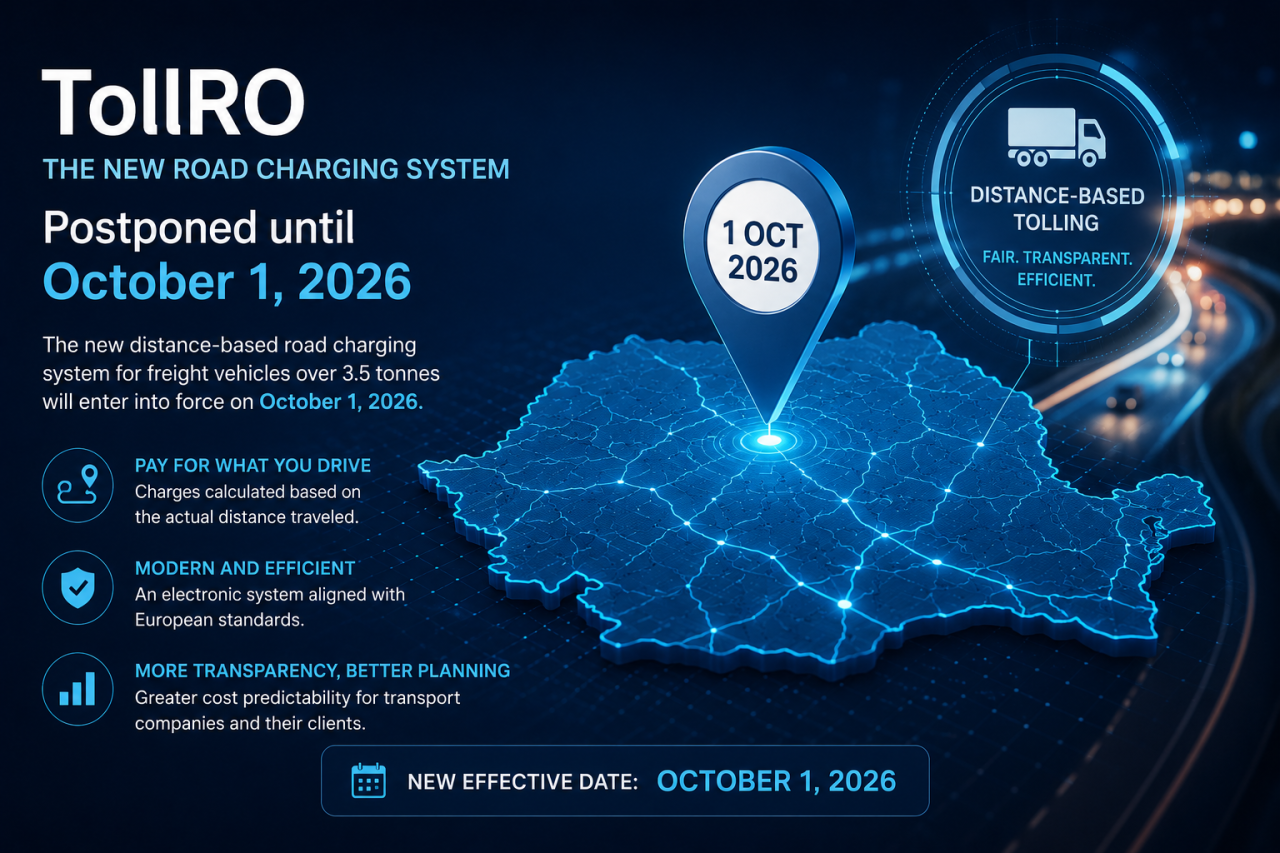
Romania’s new TollRO road charging system for freight vehicles over 3.5 tonnes has been postponed until October 1, 2026. The system is expected to replace the current vignette-based model for heavy goods vehicles with a distance-based charging mechanism, where road fees are calculated according to the kilometres actually driven.
For the transport industry, this is more than a regulatory update. It is a significant change in the way road transport costs will be calculated, planned and managed. Routes, vehicle category, emissions class, fuel consumption and operational efficiency will all become even more important in daily transport activity.
What is TollRO?
TollRO is Romania’s electronic road charging system designed for freight vehicles with a maximum authorised mass of over 3.5 tonnes. Unlike the traditional vignette system, which is based mainly on time validity, TollRO introduces a model where charges are linked to the distance travelled.
The system does not apply to passenger cars. It is aimed at freight transport vehicles and mixed-use vehicles treated as freight vehicles under the new framework.
This change brings Romania closer to road charging models already used in several European countries, where infrastructure costs are linked more directly to actual road usage. For transport operators, this means more focus on route planning, cost control and operational transparency.
Why does the postponement matter?
The postponement until October 1, 2026 gives transport companies additional time to prepare. Instead of entering into force on July 1, 2026, the new system is now expected to become operational three months later.
This extra time matters because road transport is a sector where every kilometre, every stop and every hour can influence the final cost. Companies will need to review their internal procedures, update cost calculation methods and prepare their operations for a more usage-based charging model.
Impact on transport costs
With TollRO, the distance travelled will become an even more important factor in the final cost of transport. Under the current vignette-based approach, the fee is generally linked to a period of use. Under the new model, road charging will be connected more directly to the actual route.
For clients, this means that choosing a well-organised transport partner becomes even more important. Efficient route planning, fleet coordination and reliable logistics management can help optimise costs while maintaining predictable delivery standards.
What does this mean for refrigerated transport?
In refrigerated transport, planning is already critical. Temperature-sensitive goods require strict control, precise timing and reliable route management. Unnecessary delays, poor route choices or operational inefficiencies can affect both delivery performance and product integrity.
With the introduction of TollRO, route efficiency will matter not only for delivery times, but also for cost management. Refrigerated transport already involves additional responsibilities: maintaining the required temperature, monitoring cargo conditions, respecting delivery windows and protecting sensitive goods throughout the entire journey.
In this context, the new road charging system highlights the importance of working with a logistics partner that combines compliance, safety and operational efficiency.
Preparing for the new rules
For transport companies, adapting to TollRO will not simply mean paying a new road fee. It will require a more detailed approach to route planning, fuel efficiency, transit times and pricing structures.
Companies that already rely on modern fleet monitoring, route optimisation and clear internal procedures will be better prepared for the transition. In a competitive logistics market, the difference will increasingly be made not only by price, but by reliability, transparency and the ability to deliver consistently.
Conclusion
The postponement of TollRO until October 1, 2026 gives the Romanian transport industry more time to prepare, but the direction remains clear: road charging is moving toward a more precise, distance-based model.
For clients, this change reinforces the importance of choosing a transport partner with strong operational discipline, reliable planning and a clear understanding of regulatory changes. In a market where rules and costs are evolving quickly, predictability and professionalism are becoming more valuable than ever.